Friday, May 30, 2008

Dangerous Dames

Alright so the cover looked like crap, the back read like a really hokey story that was no where near believable. I normally wouldn't have given this book a second glance. However events conspired against me. I had gotten two tickets to go see the priemier showing of "Where in the World is Osama Bin Laden?" My wife was at work so I went with one of the guests from Keycon Liana K. Of course we ended up getting there early so what else does one do while waiting for a movie. We went to the big book store in the mall.

Together we wandered through the section discussing various writers and books that we had enjoyed and would recommend. This was her recommendation, I suggested Krushiels Avatar in the end after we looked at various books. I walked out with this one and she walked out with my recommendation and three other books on Winnipeg.


I was pleasently surprised with my purchase and hope Liana K was as well. The book reads like an old dime store Detective novel like Sam Spade or something along those lines. The big difference is that instead of being set in some gritter underworld city like New York it is set in the future. The year 2057 to be exact and a lot has changed, there is teleportation, holograms, hover cars and all make and manner of robots and ray guns. If you have ever seen the Popular Science magazines of the forties and fifties is kind of has that feel and look to it. I guess you could say it is a Pulp Future Setting.

The main character Zach is the last legal and fully licensed detective in the world. They offer a very good explaination as to why there are no more licenced detectives in the book so I won't repeat it here other than to say the reasoning was sound and believable. In an attempt to keep the review spoiler free I won't go in to either of the two stories in the book. I want to keep the mystery intact. I will say I enjoyed the second one more then the first but that having read "The Plutonium Blonde" first did make the second story much more enjoyable.

Wednesday, May 14, 2008

What buddha didn't teach

I find myself enthralled as I read about author Tim Ward’s experience living in the International Forest Monastery. The book offers a candid look at life in Thai monastery told from Tim Ward’s own point of view and experiences. He also shares some of the experiences of those he met along the way on his journey. I cannot help but wonder how some of the other monks would feel about it should they know what he wrote about them.

Tim and an American named Jim arrive at the Monastery at basically the same time and the two of them basically become the main characters of the book. The rest of the monks basically made them in to twins at the start of the book by not being able to tell them apart and often referring to them as the one. While not something they desired originally lead to the two of them bonding over the course of the book and leads a number of interesting conversations.

Am about half way through the book at this point and only have one thing that I dislike about the book is that as the reader we have no real sense of time. At first we know a few days passed because he took his oath and had his head shaved. Slowly however over the course of the book both Tim and Jim begin to notice things that they have moral and ethical problems with. For example they as novices are often indirectly asked to do things against the percepts by the older monks who can’t do something for themselves because it is against the rules. Of course they also can’t ask directly because that to is against the rules. As they see more and more of this and other behaviours they find themselves questioning if the monks are truly enlightened or if they are just lazy people who have found there perfect place in life. Sadly because the book doesn’t offer any time frames we are left with no idea of how long this took.

I want to end on a positive note because over the entire book has been very good so far. So to close at least for now I’m going to mention the rest of the cast, Tim has gone to great lengths to reveal little bits about each of the different characters at the monastery. So many of them are interesting and offer little bits of there own secrets out through the story.

Tuesday, May 13, 2008

The God Delusion By Richard Dawkins - Closing thoughts

So despite how much am enjoying the new book and really want to write about it I felt I had to offer some closure to the God Delusion. As I look back at the various topics it raised and thoughts it provoked I have to say am very glad that I read it and would recommend it to others as a book to read as well.

As someone who reads a fair amount of religious and spiritual books this was a drastic change for me. The majority of the book focused on Christianity and Islam after all they are the largest part of his target audience so it only seemed fair that they received the lion’s share of the attention. That being said he didn’t leave others out completely he did offer a few references to Zeus and his fellow Greeks. The closest he comes to touching on things like magic is a section on the power of prayer and some studies that were done on the subject.

Richard Dawkins offers up a well laid out argument against religion (any religion) through out the book. He builds on points that he as already made in the book and from time to time refers to points that he will be discussing later in the book. Any argument he that makes are also backed up by science or historical facts. So it makes it very difficult to dismiss or ignore any of points he brings up.

Through out the book a fair amount of devoted to the problems caused by being religious or by religious people. He also shines spot lights on the various and numerous inconsistency that dominant the Christian and Muslim. As I read often found myself having to remind myself of one of the tenants of my own practice, that being “I honour your god” It’s easy when you reading a book like this to forget that. After all if my worship is to be respected and accepted I must in turn accept theirs. (Shame this doesn’t work both ways for the most part)

I haven’t lost my faith after reading it, I have no desire to rush out and become a Humanist. My faith in the God and the Goddess is unshaken and strong as ever, what did leave me with was a much deeper understanding of the Christian faith. It also left me with a strange desire to stop at my local Christian book store and buy an Anti Wicca book just to give it a read.


So pick this book up and give it a read you will be glad that you did.

Monday, May 12, 2008

A new book - "What the Buddha Never Taught" by Tim Ward


So you may have noticed I've updated my book shelf having finished the "God Delusion" over the weekend. I pulled 'What the Buddha Never Taught' off the shelf. I'm only a few pages in to the book and have really enjoyed it so far. It reads a lot like a Douglas Adams book I read a number of years ago, which in my opinion is a very big plus for any author.

It is a personal story retelling the author's own experiences when he traveled through Thai land and spent a number of months living with and mediating with Wat Pah Nanachat Bung Wai 'International Forest Monastery' He has only spent his first night in the Monastery and has just been introduced to the Ajahn (The head of the Monastery) and is being taught the 8 Percepts by which he is to live.

  1. To refrain for killing. This includes not killing anything from humans right down through to insects.
  2. To refrain from taking that which is not given. Don't steal and also ask before using communal belongings.
  3. To refrain from incorrect speech. Don't lie, gossip, or even talk when it isn't required.
  4. To abstain from all erotic behaviour. Including masterbation.
  5. To refrain from Alcohol or drugs that lead to heedlessness.
  6. To refrain from taking food at improper times. The monks only eat one meal a day and that is at 8am.
  7. To refrain from singing, dancing, listening to music, watching shows wearing perfumes or beautifing products.
  8. To refrain from sleeping high beds. They have mats on the floor.

If one wants to become a novice at the monestry you must also refrain from touching gold or silver. Meaning basically not touching money.

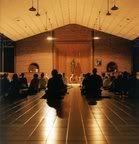
I'll continue with the reviews as I read and share what I learn along the way. I had the chance to get a few photos and even found a website for the Monestry as well.


Wednesday, May 7, 2008

Is faith evil?

So am getting close to the end of Richard Dawkins book "The God Delusion" and once I've finished I'll post a over all review of the book and my thoughts on it. I've also downloaded a 2 part BBC show that he took part in called "The Root of all Evil" he disliked the name. However the BBC wanted to use it to get peoples attention. Either way it goes well with today's blog about the book.

Like with any talk on religion I honestly don't believe that these things describe everyone who believes. However it certainly does apply to what I would like to think of as a very vocal minority.

The section I just finished was entitled "What's Wrong with Religion" he over the course of the chapter he covers a lot of material and makes a number of interesting points. I won't go in to all of them but will mention a couple that caught my attention. I think the most interesting one was the importance placed and not placed on life. For example the importance placed on the unborn life of a newly conceived baby, one so young it is barely more than a few cells. They cry out that it is murder and that all life is scared, even the potential of life. By that logic a woman being raped shouldn't fight back because there is the potential of life. The logic is clearly flawed in my opinion. I guess it doesn't help that many of the same people who protest and in some cases call for the deaths of Homosexuals, and murders. I would have thought all potential life would include the living.

Richard also introduces the reader to the term 'American Taliban' not a phrase he coined but one that certainly seems to fit. A lot of the quotes that the site shows go hand in hand with the believes of the Taliban just change it from Christianity. It doesn't matter if your Christian, Pagan or Atheist click on that link at the start of this paragraph and read through some of the quotes. Many of them made me just shake my head while others disgusted me. Sadly a lot of these people represent (Or pretend to represent) a large number of Christians and as such they are often seen as a representation of Christianity as a whole.

But lets get on to the real subject of this blog "Is Faith Evil?" Richard makes the argument through out the book and more directly in this chapter that Faith is Evil not just in reference to the extremists like the Taliban (In either Country) but faith in general. Here is what seems to be the root of his logic that led to it.

Faith is evil because it requires no justification and brooks no argument.

The argument continues on to say that even teachings moderate religions though not extremist in themselves are an open invitation to extremism. Due to the way all principles of faith must be respected. After all if everyone is to be expected to accept and respect your religion, you should be expected to respect others. That includes the Osama bin Laden, suicide bombers, the abortion doctor killers all of them do what they do out of faith.

Here is where I have to disagree I certainly expect people to respect my own faith path as a Wiccan. I respect people of other faiths, I don't in anyway feel the need to or the responsibility to respect any person whose faith leads them to hurt, kill or even threaten other people. My own belief includes the words "Eight words the Wiccan Rede fulfill — an ye harm none, do what ye will" To put it simply you're free to do what you want so long as it doesn't hurt anyone else. It's a straight forward and to the point I suppose you could argue that under that rule abortion wouldn't be allowed, but then you would have to figure whom the pregnancy would hurt more the unborn fetus without nerves to feel or the mother (A whole and complete person)

Faith itself isn't evil what is done in the name of faith often is. I could post a laundry list of evil things done in the name of religion and include them all. My own is in that list as well although not on the same scale as the big 3 religion, after all we haven't been around for more then a hundred years. We as people need to look beyond our faith and realize that people worship how they worship and it is up to them to decide how they do it. Its not my(or anyone else) place to tell them what they can and can't do, so long as they are not doing it to me.

Now my own faith is a mystery religion and people who follow it are actively encouraged to study and learn. In fact people regular question the basic tenants of faith that we follow. It is through questioning that we learn and come to better understanding of the mysteries. We don't take things on blind faith, that's one of the things that love most about Wicca. I encourage people of every faith to do the same, question everything, learn and research it. All it should do is strengthen your faith, if it does something else perhaps your following the wrong path. If someone is telling you just to believe something and not to question it them maybe they have something to hide. By questioning and furthering our own understanding of our faith and our beliefs we can better stop people from doing with evil acts under the banner of our faith.

Tuesday, April 8, 2008

The God Delusion - Pagan Point of View

So as am sure you've seen on the book shelf widget on the left that one of the books am currently reading is the The God Delusion by Richard Dawkins. It's a very enjoyable read so far and am maybe a quarter of the way through it. He doesn't pull any punches in his writing style and doesn't make any excuses for his opinions. I can easily see how it could really be a difficult read for Christians to work through. While the author makes it clear from the beginning that he applies the same logic to any and all gods he does make his primary arguments against the Christian God since that will be the one that the majority of his readers will be familiar with.

As an avid reader I was pleased by the start of the book, which opens with the following instead of a dedication. Once I read that I was excited to read on.

In Memoriam
Douglas Adams
(1952 - 2001)
"Isn't it enough to see that a garden is beautiful
without having to believe that there are
fairies at the bottom of it too?"

He spells out his main goals in the preface of the book giving the readers an a good idea of where he is heading with the book. As some one who believes in the Divine, I have to say I agreed with a lot of what he had to say and his goals. The one thing that really stood out for me was the concept of a Muslim Child and a Christian Child. There is no such thing, children are far to young to make decisions about things like that. So it would be much better to describe them as children of Christian / Muslim parents. As a parent myself this idea really hit home, I remember having to deal with my eldest daughter who was raised part time in a born again Christian house hold. Where she was taught that various things where evil and would result in people 'burning in the fires of hell' . It caused a lot of problems for her and our house over the years since a lot of the people she knew at our house and liked fell in to the groups she was being taught to hate.
In the early portion of the book he uses for terms fairly regularly when talking about various historical figures.
Atheist - a person who denies or disbelieves the existence of a supreme being or beings.
Agnostic - One who believes that it is impossible to know whether there is a God.
Theist - belief in the existence of a god or gods
Deist - The belief, based solely on reason, in a God who created the universe and then abandoned it, assuming no control over life, exerting no influence on natural phenomena, and giving no supernatural revelation.
The first two terms I had heard in the past and knew what they meant, but I had never heard the term deist used before, I find the term very interesting. Despite being a Wiccan I would put myself some where between Deist and Theist. On one hand I believe in the existence of Gods and of Goddess, but am not so certain that they really care what we do one way or the other. The best description I've every used to describe it is that the Divine is like a diamond. While the various Gods and Goddess's that we use in worship are facets of that Divine source.
The book goes on to deal with common arguments in favor of a God, but again it focuses on Christian arguments in favor of a Christian God. So while they are interesting to read from a pagan prospective they are not all that relevant. Personally I've found that the majority of them I've had brought to me by Christian friends when they lean am Wiccan. In response I used a lot of the same points that are being used by Richard and the people he is quoting.
Well that brings you to the same place I am in the book. I'll post more as I read on.